Blog
From creation to curation: how to spot AI-generated CVs
Polished language is becoming cheap. Context is becoming expensive. Five patterns we keep seeing in AI-generated CVs, and what they mean for specialist hiring.

News
From creation to curation: how to spot AI-generated CVs
Polished language is becoming cheap. Context is becoming expensive. Five patterns we keep seeing in AI-generated CVs, and what they mean for specialist hiring.
From creation to curation: how to spot AI-generated CVs
From creation to curation: how to spot AI-generated CVs
Recruiting audio developers used to feel like finding a needle in a haystack. I run recruitment and contracting at The Audio Programmer, and a few years ago that meant sourcing for weeks, building the network, asking for recommendations from others in the same field.
Over the past few years, that has flipped. The candidate pool has grown, the discipline has matured, and AI tools now let anyone produce a polished-looking application in minutes.
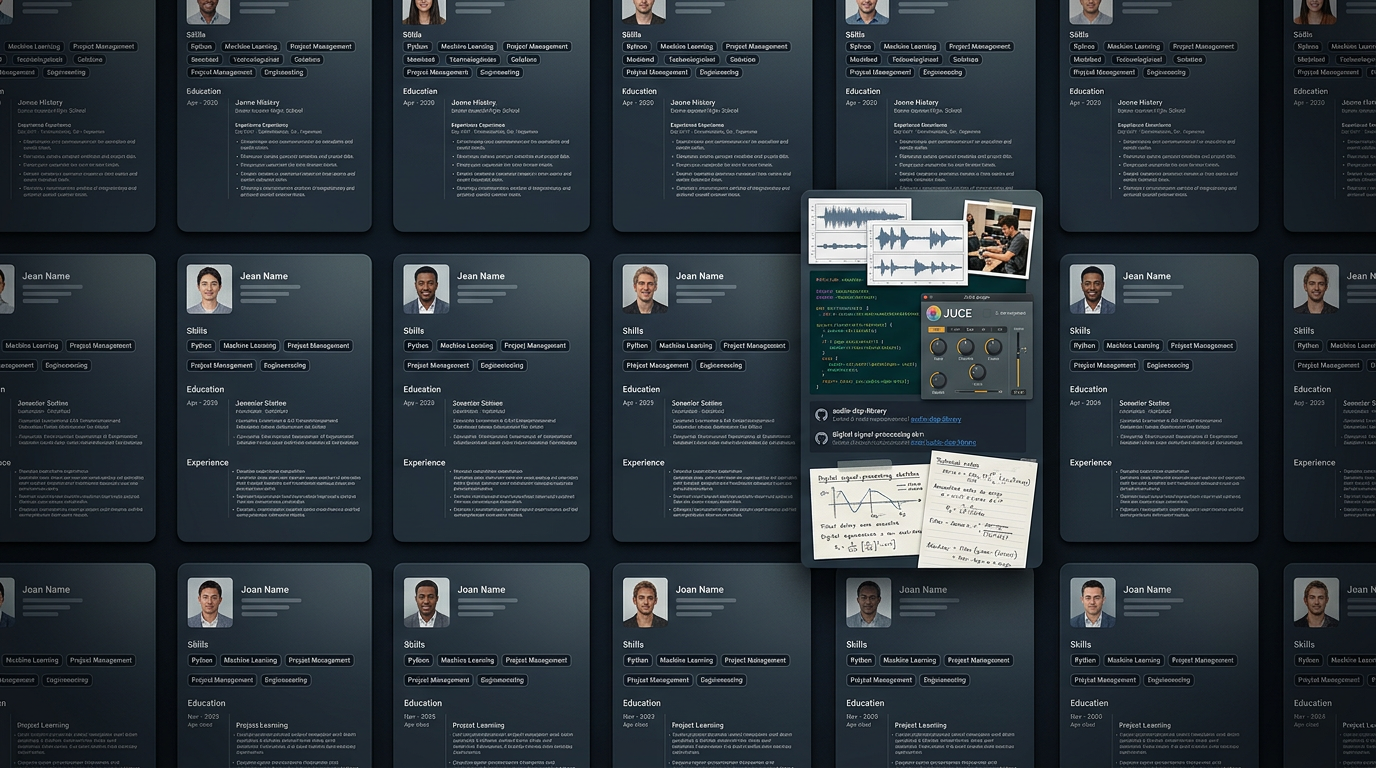
We can get more CVs for a single role now than we used to see in a month, and a noticeable share are recognisably the same template. The work is no longer finding the needle. It is learning how to filter the haystack.
The problem is not that candidates use AI. Almost everyone does now. The problem is that language has stopped being a reliable hiring signal. A polished CV no longer tells you much about whether someone can actually do the work.
The irony is that many of these CVs are being screened by AI systems trained to reward exactly this kind of language. A generic, model-written CV can score extremely highly against an AI-assisted ATS filter because both systems are optimising for keyword alignment rather than evidence of real work. The result is that fabricated candidates increasingly look better on paper than genuine specialists.
Our founder Josh calls it the shift from creation to curation. The job used to be making the shortlist exist. Now it is deciding what to throw away.
This post is a quick note for in-house talent acquisition and HR teams seeing the same shift: what AI-generated CVs look like in practice, how to tell them apart from real candidates who happen to use AI well, and what we have started doing about it.
AI is the new spellcheck. A CV with cleaner grammar than the candidate's own emails is not a problem; it just means they polished their writing. What I am flagging is a different category: CVs that are not AI-assisted so much as AI-generated, often written directly from the job ad by candidates who may not be who they claim to be. These are showing up at every seniority level.
What AI-generated CVs actually look like
The mirror effect
The candidate's headline title is a near-verbatim match for the title you advertised. The professional summary lists every keyword the ad used: "creative audio applications", "real-time audio pipelines", "generative models". Real candidates have careers; their CVs reflect where they have been, not where you would like them to go. When the CV is suspiciously aligned to your ad, the model has written it from the ad.
Generic employers, impossibly niche work
We see candidates listing senior audio AI roles at large generalist consulting firms. These are real companies, but none of them is known for audio or music technology. If someone is genuinely operating at this level in audio AI, they are very rarely doing it through a generic IT consultancy. The mismatch between employer profile and claimed work is often the clearest tell, and one of the easiest to verify with a 30-second look at what the company actually ships.
Categories instead of tools
A real audio developer names their tools: JUCE, AudioKit, Logic Pro, Pro Tools, RNBO, specific plugin SDKs. An AI-generated CV lists generic buckets: "Audio APIs", "Digital Audio Workstations", "Music production software", "Audio signal processing". These are the categories a model would generate from a job spec, not the names a working engineer would use day to day. The deeper a candidate's experience, the more specific their tooling vocabulary.
DSP described in the abstract
A real audio engineer with signal processing experience names a specific technique: FFT-based analysis, IIR or FIR filter design, polyphase resampling, sample-accurate scheduling, a specific compressor algorithm, HRTF or ambisonics for spatialisation. AI-generated CVs claim "audio signal processing", "real-time audio processing workflows", "custom signal processing algorithms", and stop there. The vocabulary is borrowed from the surface-level language of the discipline. A working DSP engineer almost always specifies what kind of processing they actually touched.
The missing footprint
For a senior engineer applying in 2026, this is the loudest red flag. Anyone with a real engineering career leaves a footprint: LinkedIn, GitHub, a personal site, conference talks, an old blog. A polished CV with zero verifiable external presence is almost always either a junior who has not built one yet, or a fabrication. Most genuine senior candidates leave some kind of footprint, even if they are not actively visible on traditional hiring platforms.
Why this matters for hiring
None of these tells is conclusive on its own. AI-assisted writing is normal now, and good candidates use it well. What changes the picture is when several patterns stack up in one CV: perfect mirror of the ad, generic consultancy employer, skills as categories, DSP claimed without specifics, no LinkedIn. That stack almost always falls apart under closer inspection.
The deeper shift is about what makes a hiring signal worth anything. Polished language is becoming cheap. Context is becoming expensive. A model can write a convincing-looking CV in seconds. What it cannot manufacture is the texture of someone who has actually shipped a JUCE plugin, debugged an ambisonic decoder, or chased a real-time audio glitch the night before a release. That texture sits in the details, not the summaries.
None of this means there are suddenly more great audio engineers. There are not. The genuine specialists are still scarce, just sitting in an inbox alongside dozens of plausible-looking near-fakes. The teams who do this hiring best are the ones who understand the niche deeply enough to tell the difference between someone describing the work and someone who has actually done it.
I hope this is useful. If you are seeing patterns we have not flagged, or you want a second pair of eyes on a tricky shortlist, get in touch.
Tessa Rowe
More Tutorials


We Built a Multi-Player Audio App With AI: Intro to Audiotool Nexus
Nexus is Audiotool's new extension layer that lets a browser-based app read and write a live project in real time, something a traditional VST can't do. Silas Gyger, lead engineer at Audiotool, shows how far an AI agent can take you by building three working apps from scratch.

More Meetups

The Audio Programmer Virtual Meetup | April 9th, 2026 @ 17:00 UK
Jani Huoponen, Scott Kramer, and Claus Trelby explore Eclipsa Audio – Google and Samsung's open-source spatial audio format – and what it means for creators working across music, film, TV, and the open web.

More News



More Articles


The audio industry is bigger than you think – and harder to hire into
Audio engineering has quietly fragmented across safety systems, embedded sensing, hearing tech and machine learning. The companies hiring in these fields are no longer just competing with other audio companies – and most of them don't realise it.