Blog
How to Create a CV That Gets You Noticed in Audio & Music Tech
Your CV is the first thing a hiring manager sees – so it needs to work hard. This guide covers exactly what audio developers, DSP engineers and plugin creators should include to stand out and land the interview.

News
How to Create a CV That Gets You Noticed in Audio & Music Tech
Your CV is the first thing a hiring manager sees – so it needs to work hard. This guide covers exactly what audio developers, DSP engineers and plugin creators should include to stand out and land the interview.
How to Create a CV That Gets You Noticed in Audio & Music Tech
How to Create a CV That Gets You Noticed in Audio & Music Tech
Breaking into the audio industry can feel intimidating, especially when your CV is the first (and sometimes only) thing a hiring manager sees. A strong CV dramatically increases your chances of landing an interview, whether through The Audio Programmer or direct applications.
This guide walks you through exactly what audio developers, DSP engineers and plugin creators should include to stand out in a competitive industry.
1. Understand What Hiring Managers Actually Look For
Hiring managers and recruiters are usually handling a lot of applications, so they want to see key information at a glance. When they first open your CV, they're mainly looking for three things:
- Skills: the technologies, frameworks and tools you can use
- Experience: evidence that you've applied those skills
- Impact: what you contributed, improved or delivered
If these aren't immediately visible, your CV risks being overlooked, even if you're highly capable.
2. Keep It Clear, Simple, and Easy to Scan
Hiring managers in audio are often developers themselves, which means they value clarity far more than decoration.
Do:
- Use clean headings and consistent formatting
- Stick to 1–2 pages
- Use bullet points instead of dense paragraphs
- Include links (GitHub, portfolio, LinkedIn, website)
Avoid:
- Long personal statements
- Tiny fonts or complex layouts
- Over-stuffed tech lists
- Burying key information at the bottom
A clean CV shows you can communicate well. That's a skill every audio team values.
3. Put Your Technical Skills Front and Centre
Your core tech stack should be instantly visible.
- Core Skills: C++, JUCE, DSP, audio algorithms, plugin development (VST3 / AU / AAX)
- Tools: Git, CMake, Xcode, Visual Studio, CI/CD tools
- Specialisms (if applicable): Machine learning for audio, spatial audio, embedded systems, iOS audio, HISE, Max/MSP, MIR
If you're early in your journey, only list skills you can actually demonstrate. Hiring managers can spot inflated skill sections quickly.
4. Show Real Projects and Trustworthy Code
The biggest barrier to getting hired in audio is a lack of demonstrable work. Hiring teams want to see plugins you've built, DSP algorithms you've implemented, university or bootcamp projects, open-source contributions, prototypes and experiments, and completed modules from TAP courses or books.
For each project, explain:
- What it does
- What you contributed
- Technologies used
Link everything to GitHub, videos or demos. Two strong, well-explained projects often outperform a long CV with no evidence of practical ability.
What makes a project stand out
Beyond just having projects, the way you present your code builds trust with hiring managers. Where possible, include:
- Clean, readable repositories with documentation or README files
- Meaningful commit histories that show how you work
- Unit tests where appropriate
- Well-structured version control
This signals that you write maintainable code, not just quick prototypes.
5. Advice for Junior Developers vs Experienced Engineers
The expectations for a junior developer are very different from those for a senior engineer.
For Junior Developers
Your goal is to show progression, curiosity and practical learning. Highlight:
- Personal projects that apply DSP or C++ concepts
- Coursework, bootcamps or self-directed learning (TAP books, courses, JUCE resources)
- GitHub repos that show consistency and improvement
- Clear explanations of your contributions to group work
- Any relevant experience: music production, electronics, maths
Show that you're developing real ability and that you can already solve small problems independently.
For Experienced Developers
Your focus should be impact, ownership and depth. Highlight:
- Plugins or products you've shipped
- Technical decisions you owned (architecture, DSP design, optimisation)
- Performance improvements you implemented
- Specialisms (filters, convolution, ML, oversampling, spatial audio, mobile audio, embedded systems)
- Collaboration with product, QA, UX or sound teams
- Leadership contributions such as mentoring or code reviews
Show that you can ship maintainable, high-quality audio software with confidence.
6. Quantify Your Contributions
Where possible, include numbers, improvements or outcomes. It instantly strengthens your CV.
Instead of: "Worked on plugin architecture and DSP."Write: "Redesigned filter architecture using biquad processing, reducing CPU usage by 30%."
Instead of: "Contributed to the team's audio engine."Write: "Integrated convolution reverb into the product's audio engine, reducing memory usage by 40% compared to the previous implementation."
Numbers tell a story quickly.
7. Tailor Your CV for Audio, Not General Software
General software CVs often miss the strengths audio teams look for. Include:
- DSP concepts you've worked with (filters, FFT, convolution, oversampling)
- Platforms you've built on (JUCE, HISE, Unity/Wwise, iOS audio)
- Audio production, sound design or music background
- Plug-in formats or engine integrations
- Relevant education or courses
Audio development sits at the intersection of engineering and creativity. Show that you understand both.
8. Avoid Common Red Flags
These issues often lead to quick rejections:
- Listing technologies like "AI", "DSP" or "C++" without evidence of using them
- Typos or formatting inconsistencies
- Overly complex or "creative" layouts
- Copy-pasted responsibilities with no achievements
A good CV is about clarity, honesty and proof.
9. Keep Personal Statements Short (Optional)
If you include one, limit it to two sentences. Here's an example that works well:
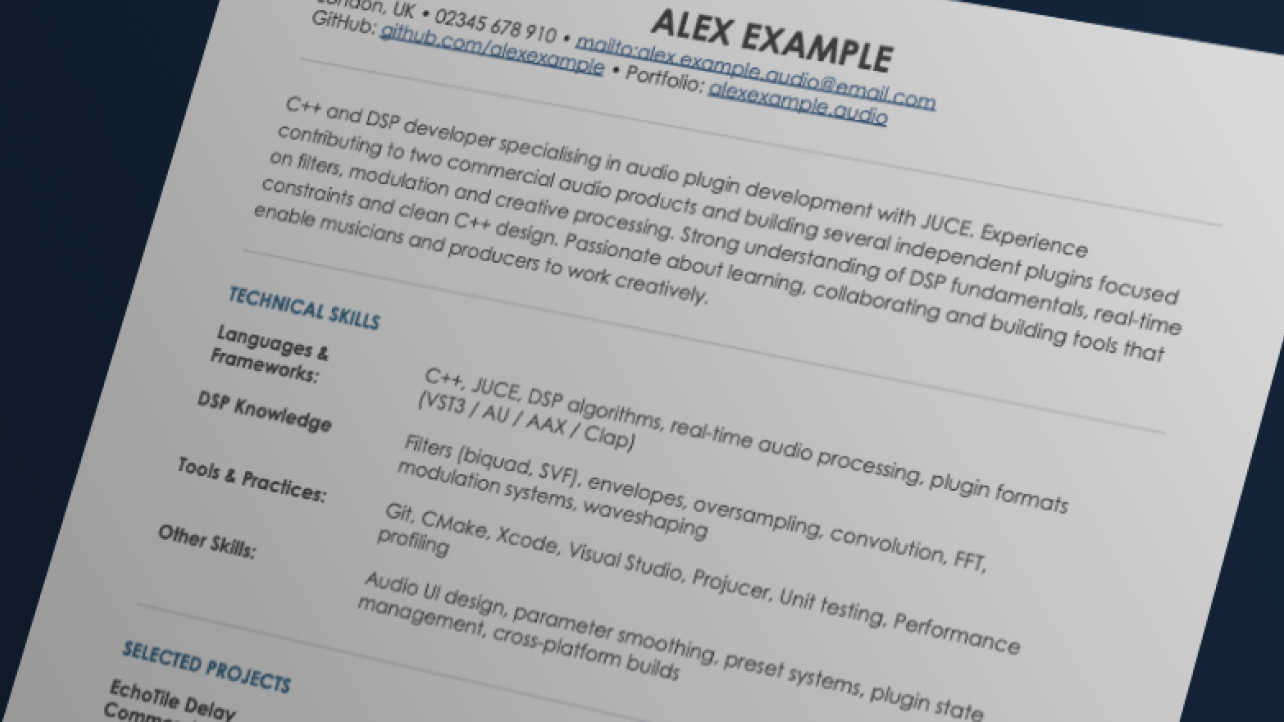
"C++ and DSP developer focused on building high-quality audio tools. Passionate about plugin development, efficient code and solving creative technical challenges."
10. Get a Second Pair of Eyes (Preferably Technical)
A reviewer – whether a mentor, another engineer or a TAP team member – can help catch technical inaccuracies, confusing explanations, formatting errors and details hiring managers expect but don't see.
If you're applying through The Audio Programmer, we can help refine your CV before it reaches a studio or client.
Conclusion
A strong CV doesn't have to be long. It needs to be clear, relevant and backed by real work. In audio, practical examples and clean communication often matter more than years of experience.
Present your skills and projects so they're easy for hiring managers to process, and you'll significantly increase your chances of landing that interview. If you'd like feedback on your CV, get in touch with us using the Contact Us button above. We're here to help you take the next step.
Tessa Rowe
More Tutorials
We Built a Multi-Player Audio App With AI: Intro to Audiotool Nexus
Nexus is Audiotool's new extension layer that lets a browser-based app read and write a live project in real time, something a traditional VST can't do. Silas Gyger, lead engineer at Audiotool, shows how far an AI agent can take you by building three working apps from scratch.
More Meetups

The Audio Programmer Virtual Meetup | April 9th, 2026 @ 17:00 UK
Jani Huoponen, Scott Kramer, and Claus Trelby explore Eclipsa Audio – Google and Samsung's open-source spatial audio format – and what it means for creators working across music, film, TV, and the open web.
More News

More Articles

The audio industry is bigger than you think – and harder to hire into
Audio engineering has quietly fragmented across safety systems, embedded sensing, hearing tech and machine learning. The companies hiring in these fields are no longer just competing with other audio companies – and most of them don't realise it.